The heart of #LesArdennes · 3 min read
One Ardennes, four countries
Borders are young. The forest is old. Long before Belgium, France, Luxembourg or Germany existed, this was one land of slate, rivers and trees. Cross the Ardennes today and you find that people on either side of every border still tell the same stories.
One forest, four names
The Romans spoke of the Arduenna silva, the largest forest in Gaul according to Julius Caesar. Today most of the Ardennes lies in Belgium and Luxembourg, and its hills run on into France and Germany. In Luxembourg it is called Éislek or Oesling, close to a third of the country. On the German side it becomes the Eifel.
Geology binds them together. The Ardennes and the Eifel are parts of the same old Rhenish Massif, reaching from north-eastern France deep into western Germany. The names change at the border. The rocks do not.
The German Ardennes: Eifel and East Cantons
The Eifel is an upland range in western Germany, in North Rhine-Westphalia and Rhineland-Palatinate, running on into eastern Belgium and northern Luxembourg. In the Volcanic Eifel lie round crater lakes, the maars, like quiet eyes in the land. The area is still volcanically active: at the Laacher See, gases still rise from the depths.
Between the Ardennes and the Eifel lie the High Fens, an upland plateau of peat bogs more than ten thousand years old. Here stands the Signal de Botrange, at 694 metres the highest point in Belgium. The Hohes Venn-Eifel nature park straddles the border, living in two countries at once.
History moved the lines here too. The area around Eupen, Malmedy and Sankt Vith belonged to Prussia until the First World War and became Belgian in 1920, after the Treaty of Versailles. Today nine municipalities form the German-speaking Community, Ostbelgien. In the winter of 1944 the Ardennes Offensive struck from the Eifel through the forests of eastern Belgium and northern Luxembourg: a wound the whole region shares.
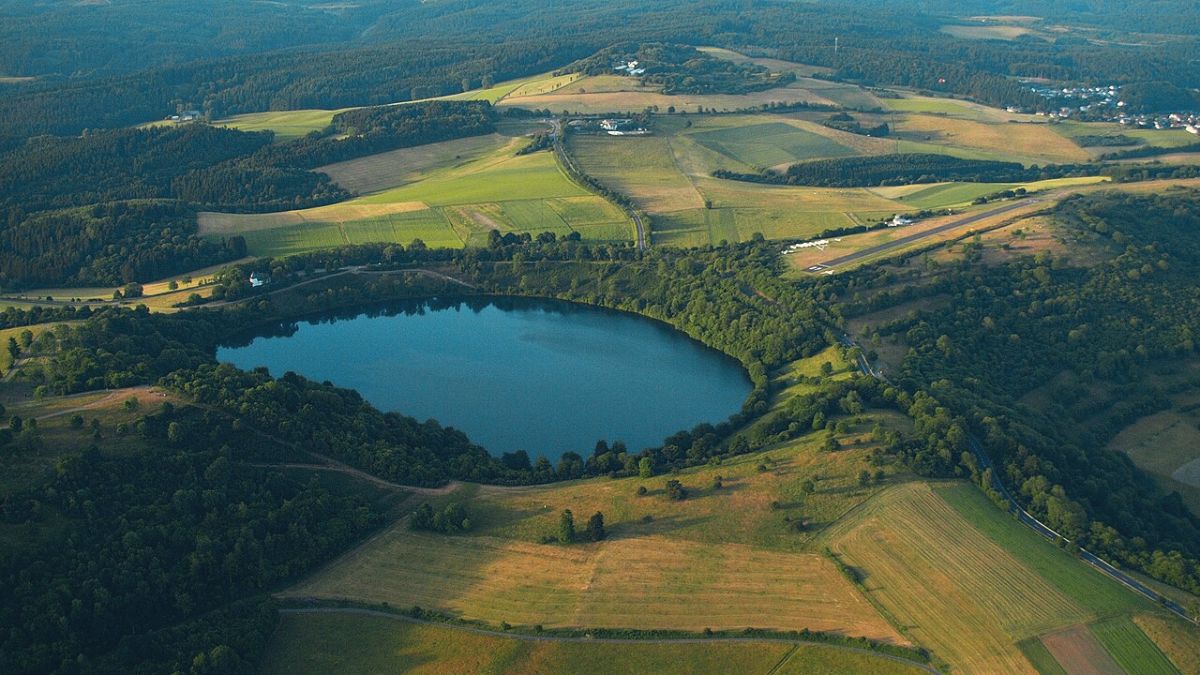
The Weinfelder Maar, also called Totenmaar, in the Volcanic Eifel: the German side of the same old massif.
Celts and Germanic peoples, always together
In this forest Celts and Germanic peoples lived side by side, and often intermingled. The Romans called the peoples of Germanic origin west of the Rhine the Germani cisrhenani. The Treveri, the people of Trier on the edge of the Ardennes forest, spoke a Celtic language. Yet according to Tacitus they claimed Germanic descent. Their culture carried traces of both.
Perhaps that is where the shared DNA of the Ardennes begins. Not in one people, but in an encounter that never stopped.
Goddesses, saints and fires
The forest had its own goddess: Arduinna, protector of the Ardennes, shown as a huntress riding a boar and identified by the Romans with Diana. Centuries later, Saint Hubert became the patron of hunters here. The old forest received a new saint, but it remained a forest of hunters.
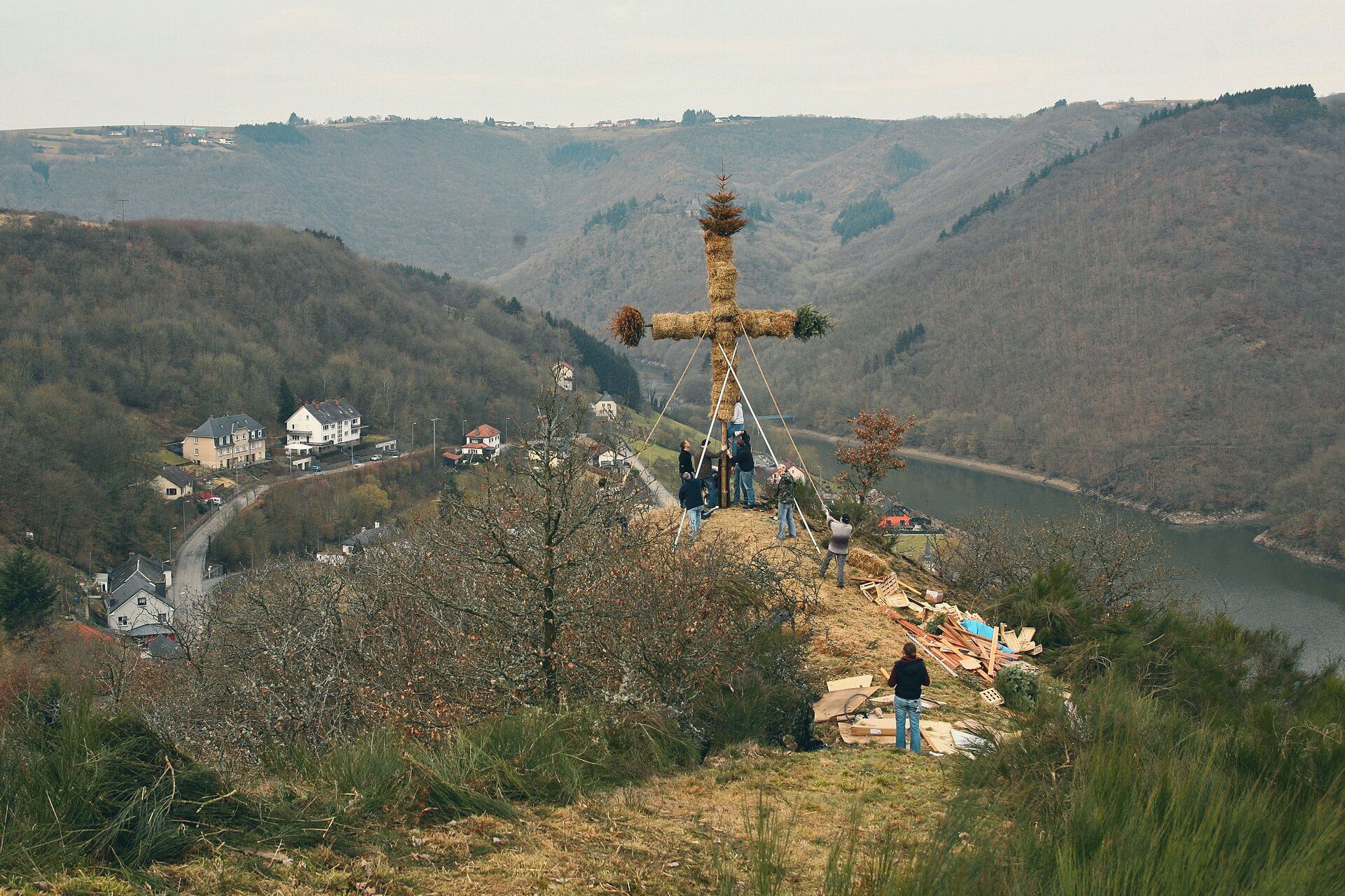
On the first Sunday of Lent, Luxembourg lights the Buergbrennen, the German Eifel the Burgbrennen, and Wallonia and the French Ardennes the feux des Brandons. Everywhere the same image: a great fire on a hill announcing the end of winter, on a date set by the church calendar. A seasonal rite in Christian dress, shared by four countries.
Bayard knows no borders
The medieval legend of the Four Sons of Aymon and their enchanted horse Bayard travelled all over Europe. In the Ardennes it lives in the landscape itself. Along the Meuse, from Dinant deep into the French Ardennes, rocks and statues mark their flight from Charlemagne. The same hero, the same rocks, the same pride, on both sides of the border.
Tchar Scaille, a cart of slate
On a hill above the glades of Monthermé, in the French Ardennes, Philippe piled up huge blocks of rock to make the Tchar Scaille. In Walloon the name means a cart of slate: the stones draw a cart pulled by two horses. At the solstice, the sun rises exactly between two of the rocks.
For Philippe it is a living site, where metal barrels become drums and festivals pass the regional culture on. In his words, the Ardennes people of four countries are “united by a whole host of strong cultural traits”: legends, music, traditions and Christian versions of pagan rituals, even if they still often see one another as foreigners. It all comes, he says, from Celts and Germanic peoples who always lived together here.
That is what #LesArdennes is about: one region, one story, in four countries.